
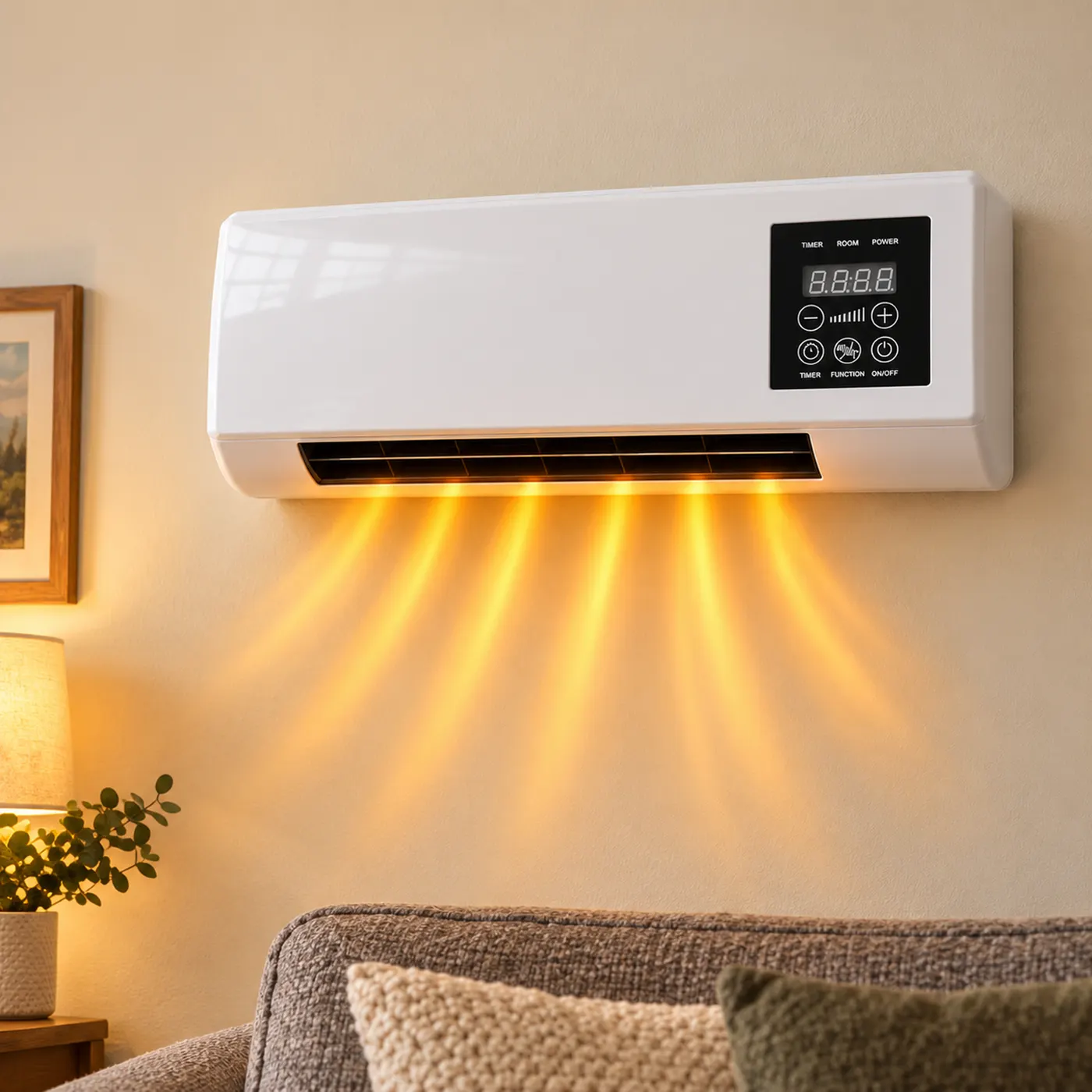
From £129
free UK delivery
About £0.53
an hour at full power
10 min
to fit, no electrician
30 days
money back
Written by the WarmFall team · Fact-checked 28 October 2026 · Sources listed below
Why mounting height matters
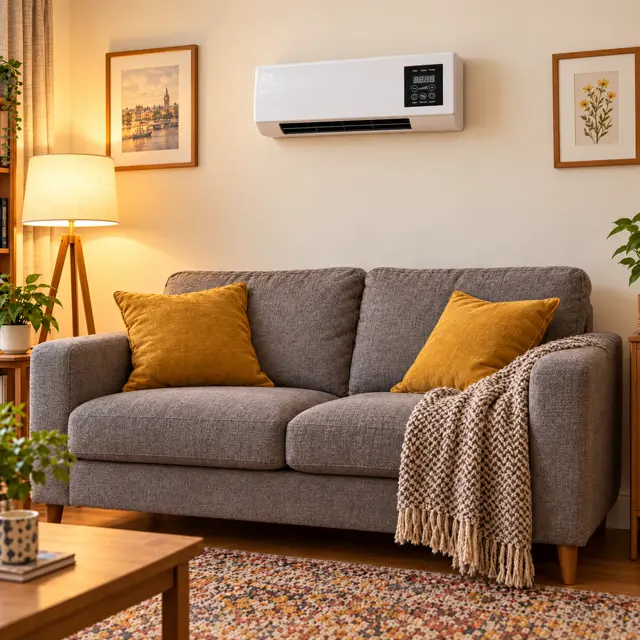
Most portable heaters sit on the floor, so their heat rises straight to the ceiling. A heater mounted around 1.8m up the wall that blows air downwards reaches the people in the room first, then spreads through the space.
Being on the wall also means no trailing lead across the floor and no hot surface at shin height, which matters in homes with children, pets or older relatives.
Features worth paying for
- Adjustable thermostat to hold your chosen temperature
- Ceramic heating element for quick, even warmth
- Overheat cut-out and auto-off timer
- Remote control so you don't need to reach the wall
- UK 3-pin plug and a fitting kit for brick, plasterboard and breeze block
How to fit a wall mounted heater
With WarmFall this takes about 10 minutes and needs only a drill and screwdriver.
- Choose a spot near a socket, clear of curtains and furniture.
- Tape the template to the wall and mark the holes.
- Drill, add wall plugs and screw on the bracket.
- Hang the heater and plug it in.
Featured pick: WarmFall
WarmFall is a 2000W plug-in wall heater with a ceramic core, adjustable thermostat, remote control, overheat cut-out and 8-hour auto-off. It mounts about 1.8m up the wall with 2 screws and blows warm air down to where you sit.
Can I mount an electric heater on any wall?
No. The wall must be suitable for the appliance and its fixings, and the heater must be installed in the way its instructions describe. Brick, block and plasterboard need different approaches; a fixing that grips securely in masonry may not hold safely in a hollow wall. Check the wall for damage and identify hidden pipes or cables before drilling. Keep to the supplied template and required clearances, and do not improvise extra holes or alter the casing. If you cannot confirm the wall construction or load capacity, ask a competent installer for advice. In rented accommodation, also check your agreement and seek permission if fixing the heater means drilling or changing the property.
Winter offer · Free UK delivery
Choose your WarmFall bundle
No account needed · Pay with Apple Pay, Google Pay, PayPal or card
- Free UK delivery
- 30-day money back
- Secure SSL checkout


You'll enter delivery details and pay by card, Apple Pay or Google Pay on our secure Shopify checkout.
How do I keep a wall-mounted heater clear and safe?
Leave the specified space around the appliance so air can move freely and heat does not build up against curtains, furniture or stored items. Do not hang clothes over it, cover its vents or place items directly below where airflow may be obstructed. Keep the plug and cable in good condition and avoid trapping the cable behind furniture. A cool-touch casing does not mean every part of a heater or its airflow is harmless to touch. Use the appliance as directed, supervise children and pets, and unplug it before cleaning. Safety features such as an overheat cut-out are useful protections, but they do not make obstructed or incorrect installation safe.
Can I use a wall heater in a rented home?
A plug-in heater can avoid changes to fixed wiring, but wall mounting usually involves drilling. Read your tenancy agreement and ask the landlord or agent before making holes if permission is required. GOV.UK explains that tenants should check their agreement and responsibilities; rules can differ across the UK, so seek local guidance if unsure. Keep written confirmation of any approval and agree how the holes should be made good when you leave. Do not remove or alter a landlord's installed electrical equipment without permission. If the heater is freestanding rather than mounted, use it in line with its instructions and store it safely when not needed.
What does a wall heater cost to run at 2kW?
The maximum running cost is calculated from kilowatts × hours × unit rate. At 26.32p/kWh, a 2kW heater used at full output for one hour costs 2 × 26.32p, which is 52.64p—about 53p. For three full-power hours, that is around £1.58. This example excludes the standing charge and uses the stated rate; your own tariff may differ. A thermostat can reduce energy use by switching the element off once the room reaches its set temperature, although it may cycle back on to maintain warmth. Actual consumption depends on the room, insulation, temperature setting and time in use.
Should a wall heater be near a socket?
A plug-in wall heater needs to reach a suitable socket without stretching, pinching or routing the cable through a hazardous position. Plan the heater and socket together before drilling, and follow the manufacturer's instructions about cable routing and clearances. Do not use an extension lead or multi-way adaptor unless the manufacturer explicitly permits it; plugging directly into a wall socket is generally the safer approach for a high-power heater. If there is no appropriate socket nearby, ask an electrician about options rather than modifying the plug or using an improvised connection. Keep the cable away from hot surfaces and walkways, and stop using the appliance if the plug, socket or cable becomes damaged or unusually hot.
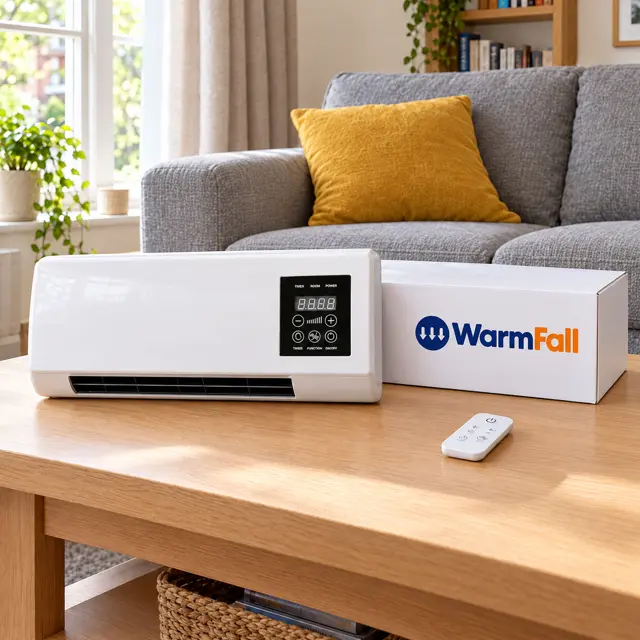
WarmFall 2000W Wall Heater
- Thermostat, remote & 8-hour timer
- Fits in 10 minutes, UK plug
- Free UK delivery · 30-day money back
Does mounting a heater high make the room warmer?
Mounting position can affect how warmth reaches people, but height alone does not create extra heat. Warm air naturally rises, so a heater designed to direct air downwards may help bring warmth towards the occupied part of the room. The result still depends on output, room layout, insulation and airflow. Follow the maker's specified mounting height rather than placing a heater arbitrarily high or low. Avoid positions where the airflow is blocked by a shelf, beam or tall furniture. If the room has a cold corner or open-plan layout, one wall-mounted unit may not distribute heat evenly everywhere; consider the room's use and size before choosing a location.
Frequently asked questions
Are wall mounted electric heaters safe?
Yes, when they have proper safety features such as an overheat cut-out and auto-off timer, and are fitted clear of curtains and furniture. Keeping them off the floor also removes trip and touch hazards.
How high should a wall heater be mounted?
Follow the manufacturer's guidance. WarmFall is designed to sit about 1.8m up the wall so it can blow warm air down over the room.
Can I mount a heater on plasterboard?
Yes, with suitable wall plugs. WarmFall's fixings work in plasterboard, brick and breeze block.
Can I mount a heater above a door?
Only if the manufacturer's instructions allow that position and all required clearances can be maintained. Check for lintels, concealed services and airflow restrictions before drilling; do not assume the space above a door is suitable.
Can a wall-mounted heater go on an outside wall?
It may be possible if the wall and fixings are suitable and the installation instructions permit it. Consider insulation, moisture, concealed services and the location of the socket. Get advice if you are uncertain about the wall.
How do I clean a mounted electric heater?
Switch it off, unplug it and let it cool first. Follow the manual, using only the recommended method; keep vents clear and do not pour liquid into the appliance or remove the casing for routine cleaning.
Can I mount a heater over a sofa?
Check the specified clearances and make sure the airflow is not blocked by the sofa or cushions. The manufacturer's mounting guidance takes priority. Avoid placing people or furnishings where they could touch the appliance or obstruct its outlet.
Do I need permission to drill in a rental?
Check your tenancy agreement and ask the landlord or agent if the agreement requires consent for drilling or alterations. Keep a record of approval, and agree what should happen to the fixing holes at the end of the tenancy.
Is a plug-in mounted heater removable?
A plug-in model can be unplugged, but the wall bracket and holes remain. Follow the instructions to remove it safely and do not pull it off the wall while plugged in. Ask permission before removing fixtures in a rented property.
Related guides
- Electric wall heaters: the UK buying guide
- Plug-in wall heater UK: no wiring, warm in 10 minutes
- Are electric wall heaters safe?
Sources
Running-cost figures are estimates based on the Ofgem price cap average of 26.32p/kWh (1 October–31 December 2026). Your costs depend on your tariff, room and usage.